Global web icon
wikipedia.org
https://en.wikipedia.org/wiki/Ishikawa_diagram
Ishikawa diagram - Wikipedia
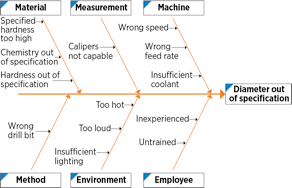
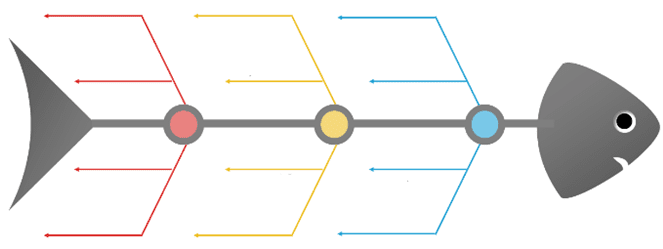
Ishikawa diagrams (also called fishbone diagrams, [1] herringbone diagrams, cause-and-effect diagrams) are causal diagrams created by Kaoru Ishikawa that show the potential causes of a specific event.
Global web icon
asq.org
https://asq.org/quality-resources/fishbone
What is a Fishbone Diagram? Ishikawa Cause & Effect Diagram | ASQ
A fishbone diagram, sometimes referred to as a cause-and-effect diagram or an Ishikawa diagram, is a quality tool that helps users identify the many possible causes for a problem by sorting ideas into useful categories.
Global web icon
learnleansigma.com
https://www.learnleansigma.com/guides/fishbone-dia…
Guide: Fishbone Diagram - Learn Lean Sigma
Fishbone diagrams, or Ishikawa cause-and-effect charts, visually organise potential root causes into themed branches, guiding teams past gut guesses to evidence-based fixes that eliminate defects, downtime, and recurring quality headaches.
Global web icon
safetyculture.com
https://safetyculture.com/topics/ishikawa-diagram
Ishikawa Diagram: A Guide on How to Use It | SafetyCulture
Ishikawa diagram, also called the Fishbone diagram, is a tool used to identify problems in a system. It shows how causes and effects are linked and helps analyze what is going wrong with systems, processes, and products.
Global web icon
investopedia.com
https://www.investopedia.com/terms/i/ishikawa-diag…
Ishikawa Diagram: How It Works, Types, and Uses - Investopedia
An Ishikawa diagram is a diagram that shows the causes of an event and is often used in manufacturing and product development.
Global web icon
citoolkit.com
https://citoolkit.com/articles/fishbone-diagram/
The Role of Fishbone Diagram in Analyzing Cause and Effect
A fishbone diagram is one of the various techniques available for conducting cause-and-effect analyses. It provides a structured way to identify and organize the potential causes contributing to a particular problem or effect.
Global web icon
kaizen.com
https://kaizen.com/insights/ishikawa-diagram-root-…
Understanding the Ishikawa Diagram | KAIZEN™ Article
The Ishikawa diagram was developed in the 1940s by Kaoru Ishikawa, a Japanese chemical engineer. Ishikawa, considered one of the pioneers in quality management, created this tool to help teams clearly visualize the various causes of a problem and how they interconnect.
Global web icon
sixsigmastudyguide.com
https://sixsigmastudyguide.com/cause-effect-diagra…
Cause and Effect Diagram (aka Ishikawa, Fishbone)
A Cause-and-Effect Diagram (aka Ishikawa, Fishbone) is a picture diagram showing possible causes (process inputs) for a given effect (process outputs). In other words, it is a visual representation used to determine the cause (s) of a specific problem.
Global web icon
spc-us.com
https://spc-us.com/ishikawa-diagram-root-cause-ana…
Ishikawa Diagram: What It Is, How It Works and Applications
Learn how the Ishikawa Diagram helps identify root causes of problems. Discover its components, real-world examples, and how to implement it.
Global web icon
leanoutsidethebox.com
https://leanoutsidethebox.com/ishikawa-fishbone-di…
Ishikawa Fishbone Diagrams: A Proven Method for Problem-Solving
Ishikawa fishbone diagrams, also known as cause-and-effect diagrams or fishbone charts, are powerful tools for problem-solving and quality management. Developed by Kaoru Ishikawa in the 1960s, these diagrams help teams identify, organize, and analyze potential causes of problems in various processes.